
Changchun Hofu Technology Co., Ltd.
Hotline: +86-431-80606168
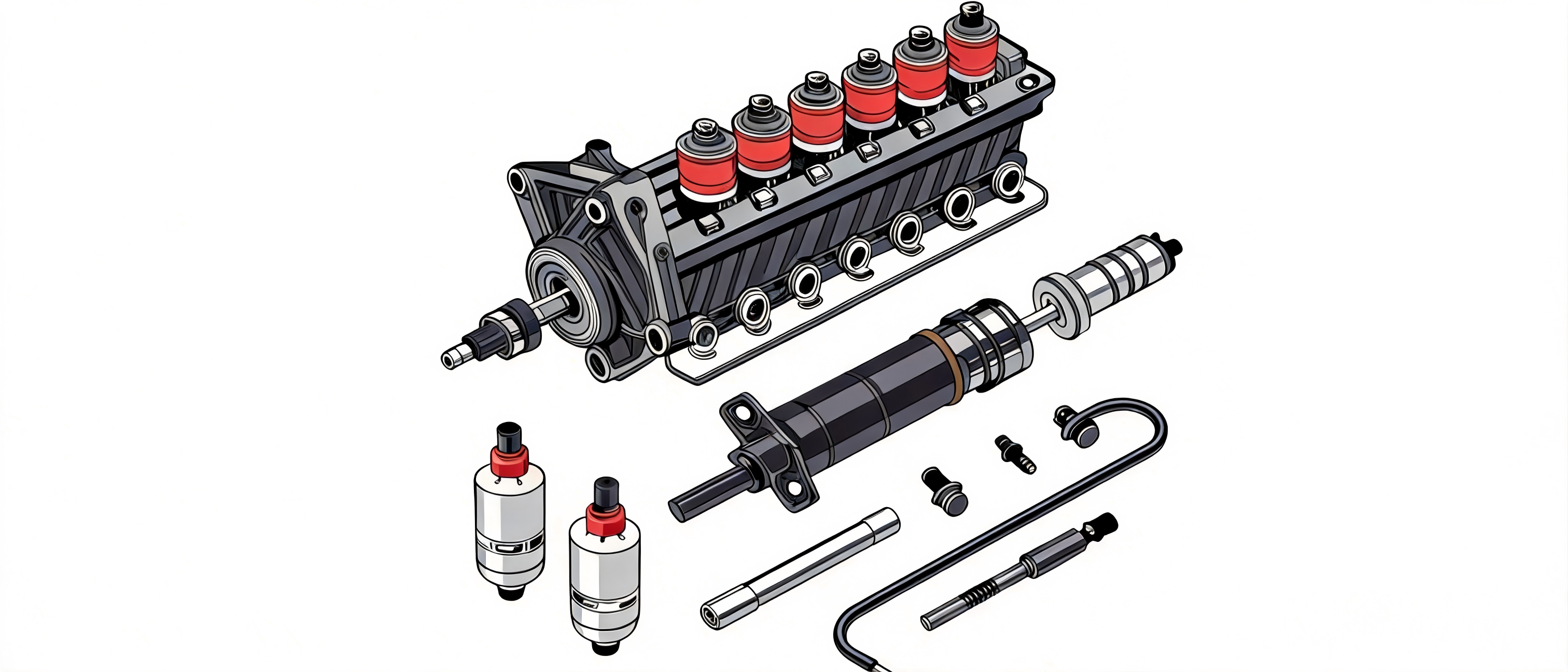
The core of the test bench lies in stably generating high-frequency pressure pulses of 0–25Hz under ultra-high pressure conditions of 540bar. This goal is achieved based on the principle of electro-hydraulic servo control:
System Configuration: The test bench adopts a closed-loop electro-hydraulic servo control system, consisting of a high-pressure hydraulic source, a high-frequency servo valve, a pressure chamber, a pressure sensor, and a digital controller, forming a closed-loop circuit.
Working Principle: The controller receives the target waveform signal (e.g., a 25Hz sine wave) set by the upper computer, compares it in real time with the feedback signal from the high-precision pressure sensor installed in the pressure chamber, calculates the deviation, and then outputs control instructions to drive the movement of the servo valve spool. The servo valve adjusts the oil flow entering the pressure chamber according to the control signal, causing the pressure inside the chamber to vary according to the target waveform.
Key Technical Aspects:
Principle of High-Frequency Implementation: To achieve a 25Hz pressure pulse, the pressure rise rate must be above 2000bar/s. According to the flow equation Q = V/β × dp/dt, under fixed chamber volume V and oil bulk modulus β, the servo valve must provide sufficient flow. This solution ensures sufficient flow supply under high-frequency conditions by optimizing the chamber volume (≤50ml) and selecting a high-flow servo valve.
The test bench supports various pressure waveforms such as sine waves, triangle waves, square waves, trapezoidal waves, ABS waves, and custom waveforms. The generation mechanism is as follows:
| Waveform Type | Mathematical Model | Generation Principle |
|---|---|---|
| Sine Wave | p = A·sin(2πft) + p0 | The controller calculates the sine function value in real time as the target instruction, and the servo system continuously tracks it. |
| Triangle Wave | Linear rising segment + linear falling segment | Set the rising and falling rates, and the controller generates linear instructions based on the slope. |
| Square Wave | Step-up - hold - step-down | The controller outputs a step instruction, and the rapid response of the servo system achieves a sudden pressure change. |
| Trapezoidal Wave | Pressurization - holding - depressurization three-stage | Segmented linear instructions, with each segment's slope independently set. |
| Custom Wave | p = f(t) | Import measured data points, and the controller performs spline interpolation and outputs them point by point. |
Composite Waveform Generation: Actual common rail pressure contains multiple frequency components. This system supports waveform superposition, allowing low-frequency pressure waves (e.g., 5Hz) and high-frequency pulsation waves (e.g., 25Hz) to be superimposed for output, realistically reproducing the complex pressure environment inside the common rail tube.
Dynamic performance evaluation of sensors requires precise comparison of amplitude attenuation and phase lag between input pressure and sensor output:
Sampling Principle: A synchronous sampling architecture is used, where the pressure sensor signal and the tested sensor output signal are connected to the same data acquisition card and triggered by the same clock source, ensuring consistent time bases for both signals. Sampling rate 100kHz (sampling period 10μs), meeting the Nyquist frequency requirements for 25Hz signal analysis.
Dynamic Error Calculation:
Frequency Response Analysis: Through sweep testing (0.1Hz~25Hz), record the amplitude ratio and phase difference at each frequency point, plot a Bode diagram, and comprehensively evaluate the sensor's dynamic response characteristics.
More than 10 million continuous cycles require high reliability and automation from the system:
Cycle Counting Mechanism: The controller has an internal hardware counter that automatically increments the count for each complete pressure cycle (pressurization - holding - depressurization or one full waveform cycle), with 100% counting accuracy unaffected by software interruptions.
Unmanned Operation Logic: After setting the target number of cycles, the system enters automatic operation mode. During operation, key parameters such as pressure, temperature, and leakage are monitored in real-time. If any parameter exceeds limits, an automatic shutdown protection is triggered. After a short failure (such as power fluctuations), the system resumes from the interruption point, ensuring test continuity.
Intermediate Inspection Mechanism: Supports setting automatic pause after every N cycles and outputting a prompt signal. After the operator conducts sensor performance inspection, a single button press resumes the test. The system records the inspection time and data, forming a complete durability test process file.
Safety protection in the 540bar high-pressure environment employs a multi-layer redundant design:
| Technical Specification | Industry Standard Level | HOFUTECH Solution | Advantage Description |
|---|---|---|---|
| Maximum Pressure | 300~400bar | 540bar | Covers the testing needs of next-generation high-pressure common rail systems |
| Pulse Frequency | 10~15Hz | 25Hz | Meets the dynamic testing requirements of high-response sensors |
| Pressure Rise Rate | 800~1200bar/s | ≥2000bar/s | Realistically simulates pressure fluctuations caused by fuel injection |
| Control Accuracy | ±1%~±2% | ±0.5%FS | More precise pressure control, better test repeatability |
| Waveform Distortion | 5%~10% | ≤3% | High waveform fidelity, more reliable test results |
Core Advantage: By combining a high-frequency servo valve (response frequency ≥80Hz), a small-volume pressure chamber (≤50ml), and a pre-compensation control algorithm, this solution achieves 25Hz high-frequency pulse output under 540bar high pressure, with a pressure rise rate of over 2000bar/s, filling the gap in the industry's high-pressure and high-frequency testing capabilities.
| Waveform Type | Technical Implementation Difficulty | HOFUTECH Solution |
|---|---|---|
| Sine Wave | Moderate | Real-time function calculation + closed-loop tracking, frequency continuously adjustable |
| Triangle Wave | Moderate | Linear slope control, independently set rising and falling rates |
| Square Wave | High | Step instruction + high-speed response, rise time ≤5ms |
| Trapezoidal Wave | Moderate | Three-stage instruction, independently adjustable pressurization/holding/depressurization times |
| ABS Wave | High | Feature point interpolation + smooth transition, simulating braking conditions |
| Custom Wave | High | CSV data import + spline interpolation, realistic simulation of actual operating conditions |
| Composite Wave | High | Multi-frequency component superposition, simulating complex pressure fluctuations |
Core Advantage: Supports seven or more standard waveforms and unlimited custom waveforms, especially the composite waveform superposition function, which can realistically reproduce the complex pressure environment during engine operation, providing more practical testing conditions for evaluating sensor dynamic performance.
| Capability Item | Industry Standard Level | HOFUTECH Solution | Advantage Description |
|---|---|---|---|
| Maximum Number of Cycles | 1 million ~ 5 million | Over 10 million | Meets the reliability verification of the entire lifecycle of the sensor |
| Continuous Operating Time | 7~15 days | Over 30 days | Reduces manual intervention and lowers testing costs |
| Sealing Life | 2 million ~ 3 million | ≥10 million | Special composite material sealing, significantly reducing maintenance frequency |
| Power Failure Resume | Not supported | Supported | Automatic recovery after unexpected power failure, avoiding test interruption |
| Intermediate Inspection | Manual Pause | Automatic Pause + One-Touch Resume | Facilitates process performance monitoring, data traceable |
Core Advantage: For the demand of 10 million durability tests, comprehensive optimization is carried out from sealing selection, automatic lubrication, fault self-recovery to intermediate inspection functions, truly achieving unmanned continuous operation and significantly improving the efficiency of durability testing.
| Capability Item | Industry Standard Level | HOFUTECH Solution | Advantage Description |
|---|---|---|---|
| Sampling Rate | 1~10kHz | 100kHz | Meets the requirement of more than 10 times sampling rate for 25Hz signal |
| Synchronization Precision | Millisecond level | <1μs | Ensures accurate dynamic error calculation |
| Acquisition Channels | 2~4 channels | 8 channels or more | Simultaneously acquire pressure, temperature, flow, and multiple sensor signals |
| Analysis Function | Waveform display | Amplitude-frequency characteristic + Phase-frequency characteristic + Step response | Comprehensively evaluate the dynamic performance of the sensor |
Core Advantage: With a 100kHz sampling rate and microsecond-level synchronization precision, combined with amplitude-frequency characteristic, phase-frequency characteristic, and step response analysis functions, this provides complete data support for evaluating the dynamic performance of sensors.
| Safety Level | Protection Measures | Response Time |
|---|---|---|
| Level 1 Protection | Software pressure limit protection | <10ms |
| Level 2 Protection | Mechanical safety valve pressure relief | <20ms |
| Level 3 Protection | Protective cover interlock | <20ms |
| Level 4 Protection | Independent emergency stop circuit | <10ms |
Core Advantage: Four levels of redundant safety protection with millisecond-level response speed ensure personnel and equipment safety in the 540bar ultra-high pressure testing environment.
| Value Dimension | Specific Manifestation | Quantitative Benefit |
|---|---|---|
| Shorten Development Cycle | Automated testing process reduces manual intervention, 24-hour continuous operation | Development cycle shortened 30%~40% |
| Improve Product Reliability | 25Hz high frequency + 540bar high pressure + 10 million cycle durability test, exposing potential defects early | Sensor failure rate reduced over 50% |
| Optimize Design Iteration | Amplitude-frequency characteristics, phase-frequency characteristics, and step response data guide design optimization | Design modification times reduced 40% |
| Verify Realistic Operating Conditions | Import measured rail pressure curves into custom waveforms, close to actual usage environment | Verification effectiveness improved 60% |
Value Explanation: The core challenge in the R&D stage is the inability to replicate the actual engine operating conditions in the laboratory, leading to performance deviations after sensor installation. This solution precisely replicates real-world conditions through 540bar high pressure, 25Hz high frequency, custom waveform import, and composite waveform superposition, identifying and resolving issues during the R&D phase. At the same time, the 10 million cycle durability test capability ensures the sensor's full lifecycle reliability is thoroughly verified.
| Value Dimension | Specific Manifestation | Quantitative Benefit |
|---|---|---|
| Improve Testing Efficiency | Parallel testing at multiple workstations, automated processes, quick clamping | Single unit testing time reduced 50% |
| Ensure Product Consistency | Standardized testing procedures, automatic judgment, controlled processes | Factory pass rate increased to above 99.5% |
| Reduce Testing Cost | Unmanned operation, automatic medium recycling, long-life seals | Testing cost reduced 30% |
| Data Traceability | Automatic storage of test data for each product, supporting traceability and query | Quality issue identification time reduced 80% |
Value Explanation: The core requirement in production testing is high efficiency, low cost, and traceability. This solution improves testing efficiency through automated processes, unmanned operation, and quick clamping design; eliminates human factors affecting testing results through standardized testing procedures and automatic judgment, ensuring product consistency; and establishes a complete data traceability system to quickly locate specific batches and test data when quality issues arise, reducing quality risks.
| Value Dimension | Specific Manifestation | Quantitative Benefit |
|---|---|---|
| Establish Testing Standards | Pre-set testing specifications to ensure consistency across different times and personnel | Test result reproducibility ≥98% |
| Reduce Customer Complaint Risk | 100% high-pressure and high-frequency performance verification before shipment, preventing defective products from leaving the factory | Market complaint rate reduced 60% |
| Authoritative Test Report | Auto-generate complete reports including waveform curves and test data | Customer quality audit pass rate increased 40% |
| Process Quality Monitoring | Real-time monitoring of test data, automatic early warning for anomalies | Anomaly detection time advanced 90% |
Value Explanation: The core responsibility of the quality department is to ensure product quality stability and reduce customer complaint risk. This solution ensures test consistency through standardized testing processes, prevents defective products from entering the market through 100% pre-shipment performance verification, and enhances customer confidence in product quality through authoritative test reports. The real-time process monitoring function allows quality anomalies to be detected immediately, preventing mass quality incidents.
| Value Dimension | Specific Manifestation | Quantitative Benefit |
|---|---|---|
| Enhance Equipment Utilization | Unmanned operation 7×24 hours | Equipment utilization increased from 60% to over 90% |
| Reduce Maintenance Costs | Long-life seals, automatic lubrication, fault warnings | Annual maintenance cost reduced 40% |
| Investment Payback Period | Efficient testing, low operational costs | Investment payback period 12~18 months |
| Production Flexibility | Scalable multiple workstations, rapid response to production capacity changes | Production adjustment response time reduced 70% |
Value Explanation: The core of operational management is equipment utilization, maintenance costs, and investment return. This solution increases equipment utilization from 60% to over 90% through unmanned operation; significantly reduces maintenance frequency and costs through long-life seals (≥10 million cycles) and automatic lubrication systems; and ensures equipment investment is recouped within 12~18 months through efficient testing capabilities and flexible production scalability.
| Value Dimension | Specific Manifestation |
|---|---|
| Technological Leadership | 540bar high pressure and 25Hz high-frequency testing capabilities meet the testing needs of next-generation common rail systems, supporting product technology upgrades |
| Market Trust | 完善的质量验证体系增强客户信任,提升品牌溢价 |
| Standard Leadership | Participate in industry testing standard formulation, gain technical authority |
| Full Lifecycle Assurance | Comprehensive coverage from R&D verification to production testing and reliability testing, building a complete quality assurance system |
| Customer Role | Core Value |
|---|---|
| R&D Personnel | Realistic operating condition replication, development cycle shortened by 30%, design optimization data support |
| Production Managers | Testing efficiency improved by 50%, single-unit cost reduced by 30%, production flexibility enhanced |
| Quality Managers | Product consistency improved, complaint rate reduced by 60%, quality audit pass rate increased |
| Equipment Maintenance Personnel | Reduced maintenance frequency, fault warning, long-life components reduce maintenance burden |
| Corporate Decision-Makers | Investment payback within 12~18 months, technological leadership advantage, enhanced market trust |
The HOFUTECH Common Rail Pressure Sensor Pulse Testing Test Bench, with its core technical advantages of 540bar ultra-high pressure, 25Hz high frequency, full waveform coverage, and 10 million cycle durability testing capability, creates quantifiable value returns for customers in R&D, production, quality, and operations. It is the preferred choice in the field of high-pressure common rail sensor testing technology.